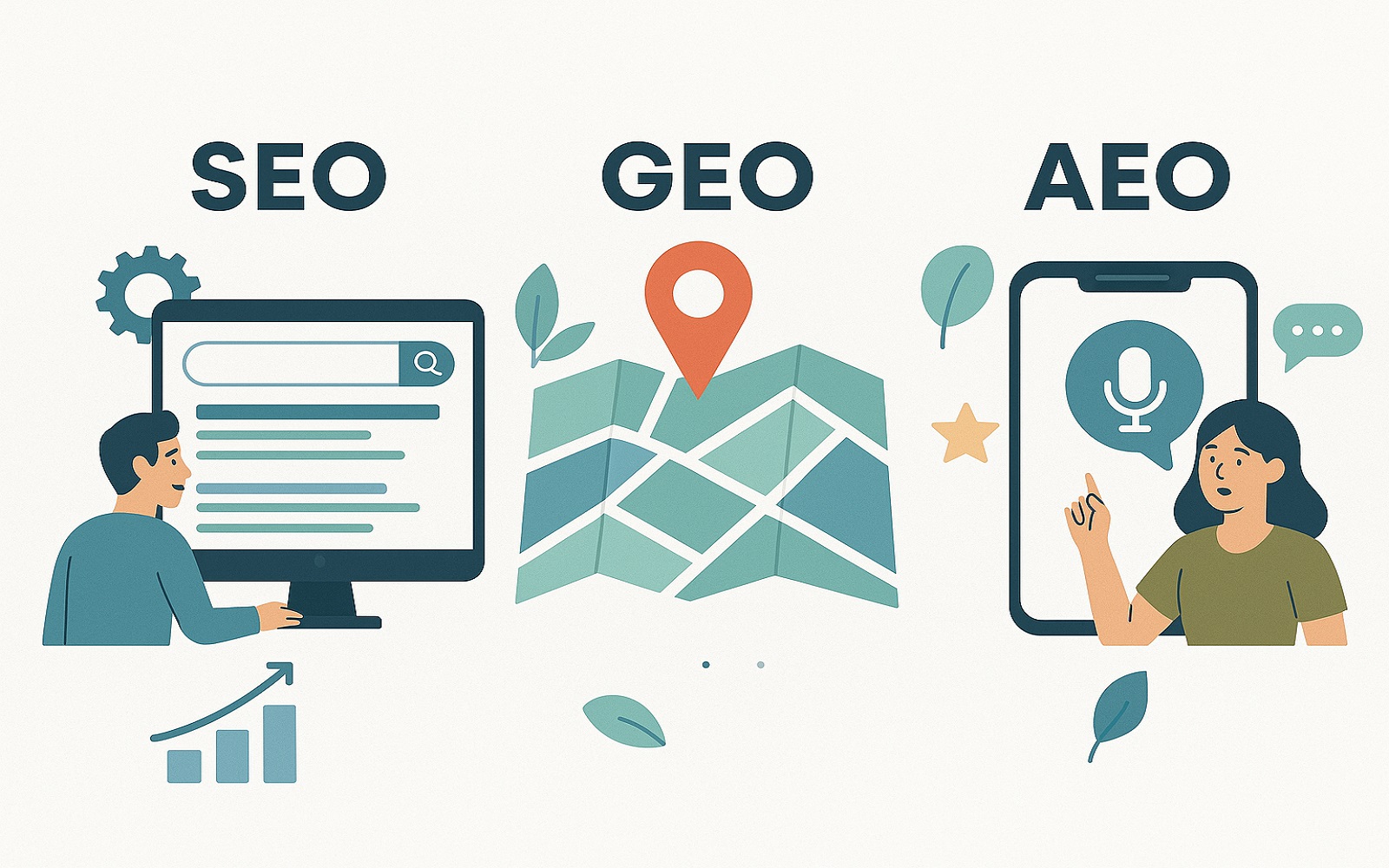
Search visibility has expanded beyond rankings. Traditional SEO still drives traffic through page-one results, but AI-powered systems now cite sources directly in answer boxes, AI Overviews, and conversational interfaces.
Psyke helps teams turn search visibility shifts into structured content strategies built for rankings, AI citations, and featured answers.
Traditional search engine rankings in organic results (the classic 10 blue links).
What success looks like:
Your page appears on page 1 of Google, Bing, or other search engines for target keywords. Metrics include keyword rankings, organic traffic, click-through rates, and conversions from search.
Primary goal:
Drive qualified traffic to your website through high rankings.
What is AEO (Answer Engine Optimization)?
What it optimizes for:
Direct answers in featured snippets, knowledge panels, and voice assistants.
What success looks like:
Your content appears as the single definitive answer to a query. Metrics include featured snippet ownership, featured snippet CTR, voice search results, and zero-click search visibility.
Primary goal:
Own position zero for high-value questions.
What is GEO (Generative Engine Optimization)?
What it optimizes for:
Being cited, referenced, or surfaced in AI-generated responses.
What success looks like:
Your content is quoted, linked, or attributed as a source in AI-generated answers. Metrics include citation frequency, citation prominence (position in the answer), and traffic from AI platforms.
Primary goal:
Become the authoritative source that AI systems trust and reference.
Quick Comparison Table
Aspect
SEO
GEO
AEO
Target Platform
Google, Bing organic results
AI Overviews, ChatGPT, Perplexity, Copilot
Featured snippets, voice assistants, knowledge panels
Success Metric
Page 1 rankings, organic traffic
Citations in AI answers
Featured snippet ownership
Content Format
Comprehensive, keyword-optimized pages
Structured, extractable, citation-worthy
Concise, direct answers to questions
User Intent
Browsing, researching, comparing
Complex queries needing synthesis
Quick factual answers
Interactive Quiz
What's Your Search Visibility Score in 2026?
Search Visibility Quiz
Your Score: /40
When to Use What: Decision Framework
The key to an effective strategy is knowing which approach to prioritize based on your content type, business goals, and where your audience is searching. Here is a simple decision framework:
Use SEO When...
You want to drive traffic to your site for conversions, lead generation, or advertising revenue.
You are targeting informational, navigational, or transactional keywords.
You have product pages, service pages, or content that requires users visits.
You need consistent, measurable traffic from search engines.
Example: A SaaS company optimizing landing pages for software comparison keywords like "best project management tools."
Stop guessing which approach to prioritize. Psyke maps your strategy so you win in every search channel that matters.
You want to own the featured snippet or voice search result for specific queries.
Your content answers common questions with definitive, concise answers.
You are targeting zero-click searches where users get their answer without clicking.
You want to dominate voice search on devices like Alexa and Siri.
Example: A financial services site optimizing for "What is a 401k?" to appear in the featured snippet and be read aloud by voice assistants.
Use GEO When...
You want to be cited by AI systems as an authoritative source.
Your audience is using AI search tools like ChatGPT, Perplexity, or Google AI Overviews.
You publish original research, data, or expert analysis that AI can synthesize.
Brand visibility and thought leadership matter more than immediate traffic.
Example: A research firm publishing industry reports that AI tools cite when answering "What are the top marketing trends in 2026?"
How AI Systems Choose What to Cite
Understanding how AI systems select sources is critical for GEO and AEO success. While the exact algorithms are proprietary, research and observation reveal several key factors that influence citation decisions across Google AI Overviews, ChatGPT, Perplexity, and other generative platforms.
Clarity and Structure
AI systems favor content that is easy to parse and extract. According to Google's Search Quality Rater Guidelines, well-structured content with clear headings and logical organization helps both users and algorithms understand the information. This means:
Clear headings that match the question being asked.
Short, scannable paragraphs that get to the point quickly.
Logical hierarchy and organization (H1, H2, H3 tags used properly).
Semantic HTML that signals importance (lists, tables, definitions).
Retrieval-Friendly Formatting
Content that is easy for AI to retrieve and quote uses structured data and clear formatting. According to Schema.org documentation and Google's structured data guidelines, proper markup helps search engines understand and categorize content. Content that is easy for AI to retrieve includes:
Self-contained answers that do not require reading the entire page.
Tables, lists, and comparison blocks that summarize key information.
Definitions and TLDRs at the top of content.
Structured data markup (schema.org) that signals content type.
Direct answers in the first 1-2 sentences of a section.
Consistency and Freshness
AI systems prefer content that is regularly maintained and aligned with other trusted sources. Content freshness is a well-documented ranking factor for time-sensitive queries, as detailed in Search Engine Journal's analysis. AI systems prefer content:
Regularly updated with current information.
Consistent across multiple pages (no contradictions).
Aligned with other trusted sources (corroboration).
Clearly dated or timestamped to indicate recency.
Authority Signals
AI systems trust content from credible sources. Google's E-E-A-T framework (Experience, Expertise, Authoritativeness, Trustworthiness) emphasizes the importance of demonstrable credentials and authoritative references. Authority signals include:
Backlinks from reputable sites in your industry.
Author credentials and bylines (especially for YMYL topics).
Citations to primary sources and data.
Domain authority and brand recognition.
Mentions and citations on other high-authority sites.
User Engagement and Behavior
While Google has stated that metrics like bounce rate and dwell time are not direct ranking factors, there is evidence that user satisfaction signals play a role in search quality.
The 2024 Google API leak revealed that Google tracks "long clicks" and engagement metrics. While the exact mechanisms remain unclear, creating content that keeps users engaged and satisfied is widely considered a best practice for both SEO and potential AI citation.
Content Formats That Win for GEO/AEO
Not all content is created equal when it comes to AI extraction. Based on analysis of featured snippets and AI citations across multiple platforms, these formats consistently perform best:
FAQ Blocks
Why it works: According to Google's documentation on FAQPage structured data, properly marked-up FAQ content is eligible for rich results in Search.
How to optimize:
Use question headings (H2 or H3) that match real search queries.
Provide concise, 2-3 sentence answers directly below each question.
Implement FAQPage schema markup.
Short Direct Answers
Why it works: AI systems prefer definitive, extractable answers that can be quoted verbatim. SEMrush research on featured snippets shows that most paragraph-format featured snippets contain 40-50 words.
How to optimize:
Lead with the answer in the first 1-2 sentences of a section.
Aim for 40-50 words for featured snippet length.
Avoid fluff, preambles, or unnecessary context before the answer.
Definitions and Glossaries
Why it works: AI systems use authoritative definitions for entity recognition and knowledge graph building.
How to optimize:
Use bold text for the term being defined.
Keep definitions under 50 words.
Link to related terms and concepts.
Comparison Blocks
Why it works: AI systems use comparison content to synthesize answers to "versus" and "best" queries. Research shows comparison tables frequently appear in featured snippets.
How to optimize:
Use tables to compare features, pricing, or specs side-by-side.
Include clear headers and labels for each comparison point.
Provide a summary recommendation at the end.
TLDRs and Summaries
Why it works: Summaries give AI systems a quick, extractable version of your content, increasing the likelihood of citation in AI-generated responses.
How to optimize:
Place the summary at the very top of the page (after the title).
Keep it to 3-5 bullet points or 2-3 sentences.
Use bold or distinct formatting to make it stand out.
Step-by-Step Sections
Why it works: Procedural content is perfect for how-to queries and voice assistants. Properly formatted content is eligible for rich results.
How to optimize:
Use numbered lists for sequential steps.
Start each step with an action verb.
Implement HowTo schema markup.
Transform your content into visibility machines. Psyke uses these exact formats to maximize your reach.
Link to related content on your site using descriptive anchor text.
Create topic clusters with a pillar page linking to supporting articles.
Ensure internal links add context and value (not just for SEO).
Entity Clarity
Clearly define key entities (people, places, products, concepts) the first time they appear.
Use consistent terminology throughout the page.
Link to authoritative sources for entity verification.
Heading Structure
Use only one H1 per page (the main title).
Use H2s for main sections, H3s for subsections.
Make headings descriptive and question-based where appropriate (e.g., "What is SEO?").
The Role of E-E-A-T in GEO
E-E-A-T (Experience, Expertise, Authoritativeness, Trustworthiness) is not just an SEO concept. It is critical for GEO. AI systems prioritize content from credible sources, especially for YMYL (Your Money or Your Life) topics like health, finance, and legal advice, according to Google's Search Quality Rater Guidelines.
Authoritativeness
What it means: Recognition and reputation within the industry.
How to demonstrate it:
Earn backlinks from reputable sites in your niche.
Get cited or mentioned by industry publications.
Publish original research or data that others reference.
Build a strong brand presence through content marketing and PR.
Trustworthiness
What it means: Reliability, accuracy, and transparency.
How to demonstrate it:
Use HTTPS and ensure site security.
Display clear contact information and privacy policies.
Fact-check content and cite credible sources.
Update content regularly to ensure accuracy.
Avoid misleading headlines or clickbait.
Experience
What it means: First-hand experience with the topic being discussed.
How to demonstrate it:
Include case studies, personal anecdotes, or examples.
Use phrases like "In our experience" or "We tested."
Show evidence of hands-on testing or real-world application.
Expertise
What it means: Deep knowledge and qualifications in the subject area.
How to demonstrate it:
Include author bios with credentials and qualifications.
Link to author profiles, LinkedIn, or professional portfolios.
Cite research, data, or expert opinions.
AI systems only cite trusted sources. Psyke builds the credibility signals that make your content citation-worthy.
Conversions: Track goal completions from organic traffic.
Backlinks: Monitor referring domains and link quality.
Measurement and Reporting: Tracking Success Across SEO, GEO, and AEO
Measuring success in GEO and AEO is more challenging than traditional SEO because the data is less accessible. Here is how to track each:
AEO Metrics
Featured snippet ownership: Track how many featured snippets you own for target queries (tools: SEMrush, Ahrefs).
Voice search visibility: Test queries on voice assistants (Alexa, Siri, Google Assistant) to see if your content is read aloud.
Zero-click search impressions: Monitor impressions vs. clicks in Google Search Console (high impressions, low clicks may indicate featured snippet success).
Knowledge panel appearances: Track if your brand or content appears in Google Knowledge Panels.
GEO Metrics
Citation frequency: Manually search queries in ChatGPT, Perplexity, and Google AI Overviews to see if your content is cited.
Citation prominence: Track whether you are cited first, second, or third in AI answers.
Referral traffic from AI tools: Monitor traffic from perplexity.ai, chat.openai.com, etc. in Google Analytics.
Brand mentions: Track how often your brand is mentioned in AI-generated answers (tools: BuzzSumo, Brand24).
Proxy metric: Increased backlinks and brand mentions on authoritative sites (a signal that AI systems may trust you more).
Attribution Challenges
One of the biggest challenges with GEO and AEO is attribution. Many AI-generated answers do not drive direct traffic, yet they build brand awareness and trust. To address this:
Track assisted conversions (users who saw an AI citation before converting later).
Use surveys or customer interviews to understand how people discovered your brand.
Monitor branded search volume as a proxy for awareness.
According to Pew Research Center's analysis of Google AI Overviews, clicks to traditional search results drop by 47% when AI Overviews appear (from 15% to 8%), highlighting the importance of tracking AI citation metrics alongside traditional SEO metrics.
Implementation Strategy for Teams
Rolling out a GEO and AEO strategy requires coordination across content, SEO, and development teams. Here is a practical implementation roadmap:
Implementation Strategy for Teams
Identify high-traffic pages and pages that already rank for target keywords.
Flag pages with poor structure, missing schema, or fluff-heavy intros.
Prioritize pages based on traffic potential and conversion value.
01
Retrofit Existing Pages
For existing high-performing pages:
Add a TLDR or summary at the top.
Convert existing content into FAQ format where appropriate.
Implement relevant schema markup.
Tighten intros to lead with the answer.
Add or improve internal links to related content.
03
Prioritize Updates
Not all pages need to be optimized at once. Use this prioritization framework:
High priority: Pages that already rank on page 1 but are not being cited by AI systems.
Medium priority: Pages ranking on page 2-3 that could benefit from improved structure and schema.
Low priority: Older content with low traffic that may need a full rewrite.
02
Build New Content with GEO/AEO in Mind
For new content:
Start with an answer-first structure from the outset.
Build FAQ sections and comparison tables as standard practice.
Implement schema markup during the content creation process.
Ensure all new content has clear author credentials and E-E-A-T signals.
04
Test and Iterate
Manually test queries in ChatGPT, Perplexity, and Google AI Overviews.
Monitor featured snippet ownership and citation frequency.
Adjust content based on what is and is not being cited.
Continuously refine your approach as AI systems evolve.
05
From audit to execution to tracking, Psyke handles it all with a clear, actionable roadmap.
Even with the best intentions, teams often make mistakes that hurt their GEO and AEO performance. Here are the most common pitfalls:
Mistake 1
Over-Optimizing for Keywords
The problem: Stuffing keywords makes content unnatural and harder for AI to extract.
The solution: Write for humans first, AI second. Use natural language and focus on answering questions clearly.
Mistake 6
Not Testing AI Queries
The problem: Assuming your content will be cited without testing it in actual AI systems.
The solution: Regularly search your target queries in ChatGPT, Perplexity, and Google AI Overviews to see if your content is being cited. Adjust accordingly.
Mistake 5
Ignoring E-E-A-T
The problem: AI systems prioritize credible sources. If your content lacks author credentials, citations, or trust signals, it will not be cited.
The solution: Invest in building authority through backlinks, author bios, and transparent sourcing.
Mistake 4
Content That is Correct but Not Extractable
The problem: Your content may be accurate and comprehensive, but if the answer is buried in paragraph 5, AI will not cite it.
The solution: Lead with the answer. Make key information easy to extract and quote.
Mistake 3
No Structure
The problem: Walls of text without headings, lists, or clear sections make content impossible for AI to parse.
The solution: Use hierarchical headings, bullet points, and tables to organize information logically.
Mistake 2
Writing Fluff
The problem: Long-winded intros, unnecessary preambles, and filler content dilute your message and make it harder for AI to find the answer.
The solution: Get to the point immediately. Every sentence should add value.
FAQs
What is the difference between SEO, GEO, and AEO?
SEO (Search Engine Optimization) focuses on ranking in traditional search results to drive website traffic. GEO (Generative Engine Optimization) focuses on being cited by AI systems like ChatGPT, Perplexity, and Google AI Overviews. AEO (Answer Engine Optimization) focuses on owning featured snippets and voice assistant responses. The most effective strategies integrate all three for comprehensive visibility.
How do AI systems decide which content to cite?
AI systems prioritize content based on five factors: clarity and structure (clear headings, scannable paragraphs), authority signals (backlinks, credentials, citations), consistency and freshness (regular updates, alignment with trusted sources), retrieval-friendly formatting (tables, lists, direct answers), and user engagement (dwell time, bounce rate). Well-structured content with demonstrable expertise is most likely to be cited.
Do I still need traditional SEO if AI is taking over search?
What is E-E-A-T and why does it matter for GEO?
How do I measure GEO and AEO success without traffic?
Yes. Traditional SEO remains essential because billions of searches still result in website clicks. The SEO services market reached $74.9 billion in 2025 and is projected to grow to $127.3 billion by 2030, according to Mordor Intelligence. The shift is not from SEO to AI, but from SEO alone to integrated strategies that capture both click-based and citation-based visibility.
E-E-A-T stands for Experience, Expertise, Authoritativeness, and Trustworthiness. AI systems prioritize content from credible sources, especially for YMYL (Your Money or Your Life) topics. To build E-E-A-T, include author credentials, cite authoritative sources, earn backlinks from reputable sites, and maintain accuracy through regular updates.
Measure success through proxy metrics: manually test queries in ChatGPT, Perplexity, and Google AI Overviews to check for citations, track brand mentions using tools like BuzzSumo, monitor branded search volume growth, watch referral traffic from AI platforms in Google Analytics, and track featured snippet ownership. While not perfectly attributable, these signals indicate whether AI systems trust and cite your content.
The Outlook: Search Visibility in the AI Era
Search visibility has shifted from click-based competition to citation-based selection. AI systems now choose which sources to reference and surface, often without sending users to websites at all.
The fundamental shift: Brands compete for understanding, not just rankings.
Organizations that win structure content for algorithmic interpretation, implement comprehensive schema markup, and build demonstrable topical authority.
Featured snippet ownership determining zero-click visibility
E-E-A-T signals differentiating which sources AI systems trust
Psyke builds integrated SEO, GEO, and AEO strategies: content designed to rank in search engines, get cited by AI systems, and own featured snippets simultaneously.