AI driven discovery has fundamentally changed how people search, compare, and evaluate
information. US adults increasingly use AI assistants for complex queries, while Google
continues to handle trillions of searches every year. Users now navigate two distinct search
experiences. This guide explains how brands can stay visible across both.
Search behavior has changed because people now have two reliable ways to find information.
Traditional search engines like Google continue to dominate global discovery, but
conversational AI systems such as ChatGPT are becoming a primary starting point for complex
questions.
Google recently expanded AI Overviews to more than 1.5 billion monthly users across more
than 200 countries. These AI generated summaries appear above organic results and attempt
to answer queries directly. This reduces the need for users to click multiple links to gather
information.
ChatGPT, on the other hand, provides a conversational flow that resembles a knowledgeable
assistant. Users can refine questions, ask follow ups, and receive synthesized explanations that
combine information from multiple sources.
As a result, users now move between two search experiences:
Conversational AI for explanation and reasoning
Traditional search engines for navigation and commercial intent
Businesses must understand this dual landscape to determine how to optimize content for
discovery.
AI search is different from traditional search. Instead of scanning a list of links, users receive a
direct answer created by a generative model. This answer is formed by interpreting intent,
analyzing meaning, and synthesizing information from multiple references.
Traditional search engines rely heavily on ranking algorithms, link authority, structured data, and
keyword matching. AI search relies on natural language understanding, pattern recognition, and
retrieval augmented generation.
How AI Search Works
AI search tools follow four core steps:
Interpret the full question using natural language understanding.
Identify user intent and context.
Retrieve relevant information from data, models, or external sources.
Generate a unified answer, often with reasoning or multiple perspectives.
Why AI Search Matters for Businesses
AI search changes visibility. People expect faster, clearer answers that are delivered in one
interaction. Instead of browsing multiple websites, users often stop when they receive a
complete explanation. This compresses the discovery journey and forces brands to appear
inside generative answers, not just inside ranked lists.
Key Shifts Driving AI Search Adoption
Users ask full natural language questions rather than short keyword phrases.
Direct answers often replace long scroll based research.
Users expect follow up questions to be understood without repeating context.
Content must be factually consistent and structurally clear to be extracted by AI systems.
How AI Driven Discovery Is Changing Search
Behavior
AI search reduces friction. Instead of navigating multiple blue links, users get direct answers
that summarize entire topics. This is changing how consumers find information, compare
products, and make decisions.
McKinsey estimates that AI assisted search could influence up to 750 billion dollars in consumer
spending by 2028. As more users adopt AI for research and problem solving, the traditional
search funnel becomes shorter or even disappears.
The Zero Click Shift
Zero click results occur when users get a complete answer without clicking any additional links.
This behavior has increased significantly as AI summaries appear at the top of search engine
pages.
ChatGPT Search vs Google Search: A Direct
Comparison
ChatGPT and Google Search now power two different discovery paths. ChatGPT excels at
explanation and reasoning, giving users synthesized answers in a conversational format.
Google remains dominant for navigation, real time information, and commercial intent, using
ranked links and AI Overviews to guide users toward relevant sources. Understanding how each
system works is essential for determining how your brand can stay visible across both
environments.
How Google Finds and Delivers Information
Google uses crawling, indexing, ranking, and quality signals to determine which pages appear
for a given query. Google AI Overviews now summarize information at the top of the results
page, reducing scroll depth and click through.
Google remains essential for local intent, real time updates, product research, and shopping
behavior.
How ChatGPT Finds and Delivers Information
ChatGPT uses language models combined with retrieval to:
Interpret meaning
Identify the context
Access recent information if browsing is enabled
Synthesize multiple viewpoints
Provide a unified, readable explanation
ChatGPT is strong at understanding complex questions and delivering answers that reduce the
need for users to explore multiple sources.
Adoption and Usage Trends
New data trends show how quickly AI search is entering the mainstream:
Google maintains about 90% of global search market share. Source: StatCounter
Bing, including Copilot Search, accounts for about 4.3%
AI native platforms represent less than 5% of total search volume but are growing
quickly.
77% of US ChatGPT users treat it as a search engine.
24% say they turn to ChatGPT before Google for specific queries.
Referrals from LLM platforms increased roughly 800% year over year.
These trends show that while AI tools are far from replacing Google, they are becoming a major
part of how users research, compare, and validate information across categories.
ChatGPT and Google Search excel in different parts of the discovery journey because they are
built on fundamentally different systems. Understanding where each performs best helps brands
decide how to position content across both environments. The strengths and limitations below
show why neither platform alone can support the full research-to-decision funnel.
Where ChatGPT Performs Strongly
Complex research
Scenario-based questions
Long explanations
Educational queries
Where ChatGPT Falls Short
Limited real time data when browsing is off
Less effective for local searches
Weaker for transactional intent
Where Google Performs Strongly
Navigation
Local queries
Shopping and commercial searches
Real time news and events
Where Google Falls Short
AI Overviews can suppress high ranking content
Informational queries may be resolved without clicks
These tradeoffs show why each platform plays a distinct role in the search journey.
Summary Table: How ChatGPT and Google Search Compare
The table below summarizes the key differences at a glance.
Criteria
ChatGPT
Google Search
Primary Output Style
Synthesized answers
Ranked links with optional AI Overviews
Strengths
Reasoning, explanations, multi step tasks
Real time info, navigation, local queries
Weaknesses
Limited real time data, weaker for transactional intent
AI Overviews causing fewer clicks
Ideal Use Cases
Research, learning, guidance
Commercial queries, local search, comparisons
Visibility Control
Low transparency in citations
High control via SEO
What This Means For Brands
Both systems influence different parts of the customer journey. ChatGPT drives early
understanding, education, and problem solving. Google drives mid and bottom funnel activity
where users compare options, explore providers, and make commercial decisions. A successful
visibility strategy must support both environments to avoid losing presence during critical
decision making moments.
Decision Tree: Which AI Search Engine Fits Your
Business?
Use this simple decision guide to determine whether your brand should focus more on
ChatGPT, Google, or a balanced dual strategy.
Enterprise AI Search Adoption in the US
AI search adoption among US enterprises has accelerated quickly. Organizations are using AI
for internal search, customer support search, knowledge retrieval, and documentation discovery.
Adoption Rates and Maturity
Most US enterprises now use AI in search or knowledge retrieval tasks, but relatively few have
deployed these systems across the entire organization
Together, these numbers show strong enthusiasm for AI but limited operational maturity,
especially within enterprise search
Challenges Slowing Down Full Deployment
Even with significant investment, many AI search systems remain in early rollout phases. Data
quality issues, fragmented documentation, and legacy technologies make it difficult for
companies to deploy advanced search across all teams. Governance and internal adoption
challenges also slow down progress. As a result, AI search capabilities often exist, but they are
not yet optimized or fully scaled across the organization.
Why This Matters For Brands
Enterprise adoption influences how information flows into the broader AI ecosystem. Internal
knowledge bases feed external tools, partner integrations, and AI models that use structured
content to generate answers. When a brand’s information is difficult for AI systems to extract or
interpret internally, it becomes less likely to appear in external AI-generated responses. Brands
that prepare their content and data for AI retrieval gain an advantage in both enterprise
environments and public consumer search tools.
Where Enterprises Are Using AI Search
AI search adoption is expanding into workflows where traditional search tools were slow or
inefficient. Companies are using AI to improve knowledge retrieval, customer support search,
document discovery, and internal Q&A systems that help employees find information more
quickly. A 2025 analysis from Second Talent found that large US organizations invest an
average of 6.5 million dollars per year in AI initiatives, much of which is directed toward
improving enterprise search and information discovery.
How Businesses Should Build a Dual Search Strategy
Search is no longer a single channel. Users now rely on both generative platforms and
traditional search engines to evaluate information, compare options, and make decisions. A
modern visibility strategy must support both environments by focusing on clarity, structure,
accuracy, and technical readiness. This section outlines the core principles and best practices
that help brands stay discoverable across generative AI tools and Google Search.
1. Core Principles of AI Search Optimization
AI search engines prioritize meaning over keywords. They extract information by interpreting
natural language, identifying relationships between concepts, and evaluating factual
consistency.
To perform well in this environment, content should be:
Clear and written in plain, natural language
Concise and free of unnecessary filler
Structured around direct answers
Organized with predictable hierarchy
Supported by verifiable facts
Pages should open each section with a short, direct explanation before expanding into
additional context. Generative models detect and reuse these high clarity segments when
producing summaries or answer boxes. Clear paragraph boundaries and one idea per block
also improve extractability.
2. Technical Requirements and Best Practices
Technical foundations continue to influence visibility across generative platforms and
Google Search. A well structured page makes it easier for search engines and AI systems to
analyze and categorize information.
Key technical priorities include:
Fast loading times across devices
Structured data markup (Article, FAQ, HowTo)
Mobile first layout
Logical headline hierarchy that mirrors search intent
Consistent metadata
Structured data is particularly important because it helps both Google and AI engines identify
definitions, steps, questions, and entities. This increases the likelihood of being cited in AI
Overviews or referenced by AI assistants.
6. The Dual Search Framework
Businesses must optimize for two types of user intent:
Conversational intent, where users want explanation, reasoning, and context
(ChatGPT, Perplexity, Claude)
Navigational intent, where users want providers, products, locations, or services
(Google Search)
Also,
Ensure every major topic includes a clear definition section.
Maintain a topical cluster with supporting pages.
Add structured data to improve understanding.
Provide direct answers and short data rich summaries.
Optimize internal linking to strengthen semantic relationships.
Build content that supports both long form browsing and AI extraction.
This framework ensures content remains discoverable whether a user starts in a conversational
AI tool or a traditional search engine.
5. Generative Search Marketing Strategy
A strong generative search strategy prepares content for conversational, multi step, and context
dependent queries. This approach focuses on:
Building tightly connected topical clusters to strengthen authority
Updating statistics and data points regularly
Creating answer first content that mirrors how users ask questions
Providing comparisons, alternatives, and pros and cons
Building step by step guides and scenario based explanations
Ensuring factual consistency across all pages
Improving internal linking to reinforce topic relationships
Generative AI tools evaluate brands based on patterns across their content. Cluster depth and
factual alignment significantly increase the likelihood of being cited.
Brands that only publish isolated long form pages without surrounding support content typically
perform poorly in generative ecosystems.
4. Why Traditional SEO Alone Is Not Enough
Traditional SEO remains essential, but it no longer guarantees visibility. Even a top ranking
page can lose traffic if:
A Google AI Overview resolves the query above the link
A generative summary answers the question fully
A user relies on ChatGPT instead of browsing pages
Ranking signals still matter, but visibility now depends equally on whether AI systems can
extract core information. Generative platforms reward clarity, structure, and factual alignment
more than keyword placement.
Relying solely on classic SEO creates gaps in top funnel visibility, especially as AI tools reduce
click depth and consolidate information.
3. Preparing Content for AI Extraction
Generative search systems evaluate content differently from traditional search. Instead of
matching keywords, they analyze:
Avoid mixing multiple concepts in one block of text
The Strategic Question: Should Businesses Optimize
for Both?
Generative AI has created a split in how people search. ChatGPT influences early
research and problem solving, while Google dominates navigation, local intent, and
commercial discovery. Most users move between them depending on what they
need, which means relying on a single search strategy creates visibility gaps.
ChatGPT performs best when users want clarity, synthesis, or a complete explanation of a topic.
It shapes early understanding and supports multi step questions that would normally require
several searches. This makes it a powerful channel for top funnel visibility and for influencing
how people form their first impressions about a subject or brand.
Google remains essential for mid and bottom funnel activity. Users still rely on it for local
searches, product research, commercial intent, and time sensitive information. Even as AI
Overviews expand, traditional ranking signals still determine how brands appear across
categories. For most organisations, the strategic choice is not between ChatGPT and Google. It is how to
prepare for both. A dual optimization approach ensures visibility across more stages of the user
journey and protects against traffic loss when generative summaries reduce clicks on traditional
results.
Brands that optimize only for Google risk losing influence in early research stages where AI
tools now play a central role. Brands that focus only on AI assistants risk losing relevance in
high intent searches where Google remains dominant. The strongest strategy combines
traditional SEO with content designed for clear interpretation and extraction by AI systems.
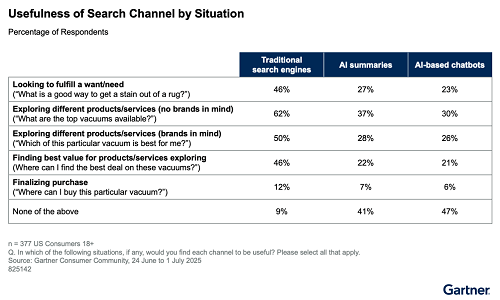
Data underlines this shift: According to Gartner, traditional search-engine volume may drop by
25% by 2026 as users increasingly turn to AI-based chatbots. And a recent survey by Deloitte
found that 53% of U.S. consumers now use or experiment with generative AI tools, signalling
mainstream adoption
How Psyke Helps Brands Future Proof Visibility
The shift toward AI driven discovery requires clarity, structured content, and a deep
understanding of how modern search systems interpret information. Many organisations
recognise the need for dual optimization but lack the internal bandwidth to execute it
consistently.
Psyke supports brands by:
Conducting AI search readiness audits
Identifying opportunities across both ChatGPT and Google
Building content structures that suit generative engines
Supporting technical implementation and structured data
Creating data backed content strategies aligned with AI behavior
Our approach focuses on maintaining visibility across conversational and traditional search
ecosystems without unnecessary complexity or disruptive workflow changes.
If you’re shaping your approach to AI search and want expert guidance on next
steps, our team is here to support you.
Should my business optimize for ChatGPT or Google?
Most brands should optimize for both. ChatGPT influences early research and problem solving
while Google remains essential for commercial intent, navigation, and local visibility. A dual
approach protects visibility across the entire search journey.
How does AI search change traditional SEO?
AI search does not replace SEO but it changes how visibility is gained. Ranking alone is no
longer enough. Content must be clear, structured, and easy for AI systems to interpret and
summarize. Pages that present direct answers and factual information perform better across
both environments.
Can ChatGPT use my website as a source?
How does Google AI Overviews affect website traffic?
What type of content performs best in AI driven search?
Yes. ChatGPT may reference your content when it contains clear explanations, consistent
phrasing, and verifiable facts that match other trusted sources. Visibility in AI assistants
depends on topical authority and how easily the model can extract key information.
AI Overviews resolve many informational queries without requiring a click. This can reduce
organic traffic even for high ranking pages. Businesses must optimize not just for ranking but for
appearing inside the generative summary where users increasingly make decisions.
Answer first content performs best. This includes clear definitions, step by step guides,
comparisons, and short standalone paragraphs. Generative systems favour content that is
factual, well structured, and easy to convert into summaries.
The Outlook: Preparing for the Next Era of Search
AI driven discovery is still developing, but adoption is accelerating rapidly. As generative
systems expand across industries, users will expect answers delivered instantly and in context.
Brands that adapt early will gain a long term advantage because their content will be easier for
AI systems to interpret, reuse, and trust.
Visibility in the future will depend on clarity, structure, topical authority, and the ability to remain
present across both conversational and traditional search environments. Preparing now ensures
stability as AI evolves.